

Understanding cell behavior, pt.3
The tendency of engineers to overuse advanced software and the battery industry in America

If you stubbornly insist on using Excel/ python/ draw.io/ FreeCAD/ (insert whatever freeware Reddit suggests) over Minitab/ Simulink/ Solidworks/ any of the various $10,000 corporate license apps peddled by sales “engineers” on Linkedin, this post is for you. You should feel good about yourself. I’m like you too!
Choosing to chain yourself to Excel to manually type out your cpk analysis even if your company has money and can give you access to Minitab, or even if your boss downloaded Minitab for you and yet you still refuse to use it, now that’s a choice I respect.
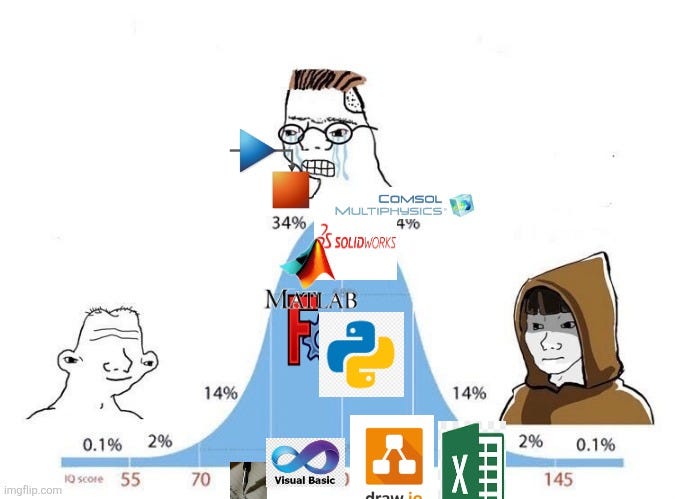
I’m not talking to people on the left side of the bell curve. There is genuinely a valid point that some people actually can’t figure out how to use Matlab, for example. These engineers are out of this conversation, they are chained to Excel because they can’t learn anything else even if it’s spoon fed to them, and despite being a sizeable portion of the battery workforce, they are irrelevant.
I’m also not talking about the spreadsheet jockeys. You know who you are. Don’t be reading “stubbornly insist on using Excel” thinking that you’re some god-tier engineering wizard. Your weekly spreadsheet tracker quick sync level set project program review session creates zero value and your employees/ coworkers/ suppliers all hate you for making them sit in your stupid meetings.
Okay, so back to the topic. The 1st problem with the widespread overuse of Matlab/ Simulink/ Comsol/ ANSYS is that they’re just not necessary for 90% of engineers. Need to make a thermal model to understand the effect of changing cell dimensions? Okay, make a resistor model with the cell internal welds and jellyroll, calculate the wattage generated at each component, and calculate the equilibrium temp using the law of cooling. Decide if you can live with that, and change the cell accordingly. Everything can be done in Excel. Can I technically make a better 1D thermal model with Matlab than Excel? Absolutely. But guess what I also have to do with Matlab? I have to wait 30 seconds for it to launch, set up the terminal, and learn the commands. With Excel, I just type and my brain takes off. It’s intuitive. I immediately engage with my problem-solving skills without the clutter that a fancy software brings.
The 2nd and probably the most problematic problem with the widespread overuse of simulation software is that it kills your problem-solving muscles. Now Tesla job posts are known throughout the industry as being super cringe, but one thing always stood out to me, which was the constant emphasis on “first principles”. When you collect 1000 data points from your station’s HMI and import them into Minitab and immediately mouse over to cpk analysis, you aren’t engaging your first principles. Okay, so you ran the analysis and the cpk is too low. Is your cpk okay on the other side? Is the cpk low because a limit is nonsense? Is it low because of a high standard deviation? Is it low because the average is off? These are all observations that you would’ve made at each step if the cpk was calculated in Excel, but now when you get a bad cpk value, you’re rusty and exposed, and it’s specifically because of the overreliance on advanced software.
The 3rd problem with the widespread overuse of simulation software is that it encourages and leads to weak decision-makers. As engineers, if we’re honest, a big draw of simulation software is that it creates nice-looking videos and graphs when we take data into reviews with the chief engineer. Comsol makes it easier for executives to look at the moving wave of colors and decide what to do. Man, that whole line of thinking is so stupid - we’re engineers, not the army! Miss me with that Completed Staff Work bullshit (look it up, it’s beyond stupid that they’re trying to bring stuff like this into the engineering world). Nuance exists, and it must be fully challenged at each step of development. The VPs/ execs/ directors/ chiefs absolutely should understand the full technical details behind decisions that they have to make and live with. The best organizations don’t have managers urging their subordinates to dumb down the technical details to “Do A, battery good. See, color green. Do B, battery not so good. See, color red!” That’s ridiculous.
Okay, so we kinda know by now that the US battery industry is not doing well. We had NMC and we gave it up to ATL. We had LFP and we gave it up to Wanxiang. We had EV1 and gave up EVs to China. I’ll tell you exactly what is happening in 2026.
Most American battery engineers are covering for an astounding lack of knowledge on how batteries actually work by overusing simulation software and other advanced tools to make bullshit 96-page slide decks that look good on the surface, but offer nothing actionable (Real experience for me). The overwhelming majority of American battery engineers are nothing more than glorified project managers, or highly-paid supplier controllers, that can’t tell you the exact pathway of charge through the pack or cell that they’re supposedly the owner of, and they would utterly fail any sort of competence test against their Chinese/ Korean/ Japanese counterparts. This kind of stuff is typical late-stage engineering, but batteries are not a late-stage product, so we’re getting obliterated on the global scene. There are reports that America is even losing in battery cell innovation now, which was supposed to be the mainstay.
The strongest battery engineer I know makes decisions by blending experimental data with what seems like a dark magic sense of intuition. It seems like he has the answer for everything, or at least, a good direction of where to look. But what no one sees is the decades he spent drawing up cell designs, tinkering until all the edge cases were covered, and his intuition was razor sharp. This guy literally only uses Excel and a notepad and his brain. But he is widely recognized for his impact. Fellow engineers, we must return to Excel.